
Industrial lifting environments demand equipment that can handle weight, friction, heat, and repeated use without compromising safety. While synthetic and chain slings each have their place, there are many applications where wire rope slings provide a stronger balance of durability and flexibility.
In fabrication plants, construction sites, shipping yards, and heavy manufacturing facilities, lifting tools are exposed to harsh conditions. Understanding where wire rope lifting slings outperform alternatives helps crews choose the right equipment for demanding operations.
High Strength-to-Weight Ratio
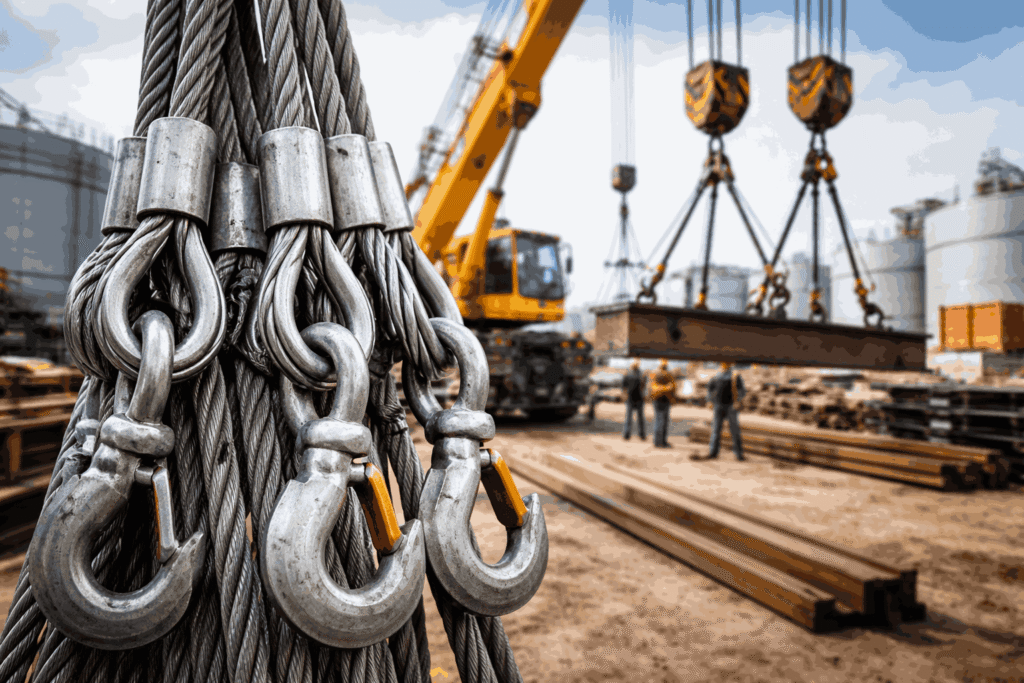
One of the primary advantages of wire rope slings is their strength-to-weight ratio. Constructed from multiple strands of high-strength steel wire twisted around a core, they provide substantial load capacity without excessive bulk.
This high strength-to-weight ratio allows operators to handle heavy loads efficiently while maintaining a manageable sling weight. In large lifting setups, reducing sling weight simplifies rigging and positioning without sacrificing performance.
Because lifting wire rope is engineered to distribute force across multiple strands, it can withstand significant tensile loads while maintaining structural integrity under tension.
Resistance to Abrasion and Heat
Industrial lifting often involves contact with rough steel edges, structural beams, and fabricated components. Abrasion is one of the most common causes of sling wear. Compared to synthetic options, wire rope lifting slings offer superior resistance to surface abrasion.
Heat exposure is another factor in industrial environments. Welding areas, steel processing plants, and high-temperature facilities can quickly degrade soft sling materials. Wire rope construction tolerates higher temperatures and is less susceptible to heat-related strength loss when used within rated limits.
This combination of abrasion resistance and heat tolerance makes wire rope slings particularly valuable in steel handling and heavy fabrication operations.
Flexibility in Choker and Basket Configurations
Flexibility is essential in rigging. Despite their steel construction, wire rope slings remain flexible enough to accommodate common hitch configurations, including vertical, basket, and choker setups.
In a basket hitch, the sling distributes weight evenly across two legs, increasing effective capacity. In choker configurations, the sling tightens around the load to provide a secure grip. The adaptability of lifting wire rope allows operators to adjust rigging configurations without switching sling types.
This versatility supports efficient jobsite operations, especially when load shapes and lifting angles vary throughout the day.
Longevity Under Repeated Lifts
High-cycle lifting environments require equipment that performs consistently over time. Wire rope lifting slings are designed for repeated loading and unloading without rapid degradation.
The multi-strand construction absorbs and distributes stress more effectively than single-component systems. While inspection remains essential, properly maintained wire rope slings often provide extended service life in demanding applications.
Their durability under repeated use reduces replacement frequency and helps maintain predictable lifting performance.
Cost-Effective for Heavy-Duty Cycles
While the initial cost may be higher than some synthetic alternatives, wire rope slings often prove cost-effective over the long term in heavy-duty environments. Reduced wear, fewer replacements, and sustained performance contribute to overall operational efficiency.
In applications where abrasion, heat, and repeated lifting cycles are unavoidable, investing in durable sling materials helps control downtime and long-term costs.
Conclusion – Built for Demanding Lifts
Industrial lifting requires equipment that balances strength, flexibility, and durability. Wire rope slings offer a high strength-to-weight ratio, resistance to abrasion and heat, and adaptability across multiple rigging configurations.
When selected based on rated capacity and maintained through regular inspection, wire rope lifting slings support safe, consistent performance in heavy-duty environments. Built for demanding lifts, they remain a reliable choice for industrial applications where durability matters most. For more details, contact Murphy Industrial Products, Inc. today!