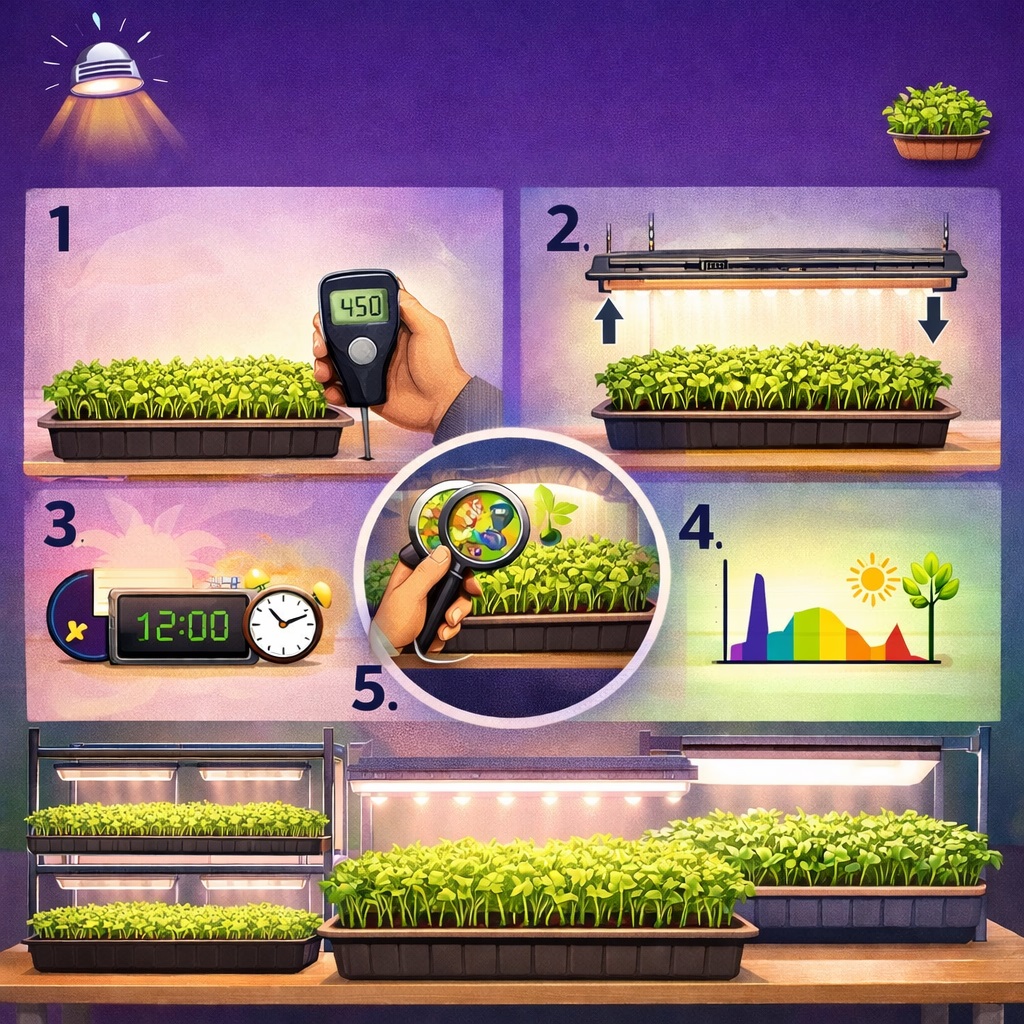

Growing microgreens in controlled environment agriculture requires precise attention to lighting conditions. The success of your crop depends heavily on how well you monitor and adjust your microgreen grow lights throughout the growth cycle. Professional growers understand that static installation doesn’t mean static management. Here are five proven methods to optimize your LED lighting for microgreens.
1. Track Growth Patterns Under Your Lighting System
Regular observation forms the foundation of successful microgreen cultivation. Professional growers establish daily monitoring routines to assess plant health and lighting effectiveness. Vibrant green coloration and sturdy stem development indicate proper light exposure. Conversely, leggy growth or pale leaves signal insufficient intensity from your grow lights for microgreens.
Document your observations systematically. Record leaf color, stem thickness, and overall plant vigor at the same time each day. This data reveals patterns that help you understand how your crops respond to current lighting conditions. Pay particular attention to uniformity across your growing area. Uneven growth often indicates inconsistent light distribution that requires fixture repositioning or intensity adjustments.
Different microgreen varieties exhibit unique responses to lighting conditions. Brassicas typically show robust growth under moderate intensity, while more delicate varieties may require fine-tuning. Understanding these species-specific requirements allows you to create optimal conditions for each crop you cultivate.
2. Optimize the Light-Dark Cycle for Plant Development
Microgreens follow natural circadian rhythms that govern photosynthesis and respiration. The photoperiod you establish directly impacts growth rate, nutrient density, and harvest quality. Most microgreen varieties thrive with 14 to 16 hours of light daily. The remaining hours of darkness allow plants to process nutrients and complete essential metabolic functions.
Consistency in your light-dark schedule proves critical for uniform crop development. Automated controls eliminate human error and ensure your plants receive precisely timed light exposure. Modern LED lights for microgreens integrate seamlessly with digital timers and control systems. This automation allows growers to focus on other critical aspects of crop management while maintaining perfect lighting schedules.
The darkness period should never be underestimated. During these hours, microgreens strengthen cell structures and allocate resources to root development. Interrupting this dark period can stress plants and reduce overall crop quality. Maintain complete darkness during off-hours to support healthy growth cycles.
3. Measure Light Intensity for Optimal Growth
Photosynthetic photon flux density (PPFD) measurement provides scientific precision to your lighting management. Microgreens require PPFD levels between 200 and 400 µmol/m²/s for optimal development. Values below this range result in weak, elongated plants. Excessive intensity can cause photo-inhibition and leaf damage.
Professional growers invest in quantum sensors to measure PPFD accurately. Take measurements at canopy level across multiple points in your growing area. This reveals whether your microgreen LED lights deliver uniform coverage. Identify hot spots and dim areas that require adjustment.
Key measurement practices include:
- Testing PPFD at multiple canopy positions
- Recording readings at different times during the photoperiod
- Maintaining consistent measurement height above plants
- Comparing readings across different growing zones
Distance between lights and plant canopy significantly affects PPFD delivery. Most commercial fixtures perform optimally when positioned 6 to 12 inches above the growing surface. Closer placement increases intensity but may create uneven distribution. Greater distances reduce intensity and improve uniformity.
4. Adjust Spectrum Throughout the Growth Cycle
Light spectrum composition influences microgreen morphology, flavor development, and nutritional content. Blue wavelengths promote compact growth and chlorophyll production. Red wavelengths drive photosynthetic efficiency and biomass accumulation. The ideal spectrum balance varies based on crop type and growth stage.
Early growth stages benefit from blue-dominant spectrums that encourage strong, compact seedling development. As plants mature, increasing red wavelengths accelerates growth and enhances yield. Advanced LED systems feature adjustable spectrum controls that allow growers to fine-tune wavelength ratios without changing fixtures.
Full-spectrum LED lighting for microgreens mimics natural sunlight and supports complete plant development. This approach simplifies management while delivering excellent results across multiple crop varieties. Growers can maintain consistent spectrum settings throughout the growth cycle with minimal adjustment.
5. Monitor Environmental Factors for Lighting Efficiency
Temperature management directly correlates with lighting system performance. LED technology operates significantly cooler than traditional high-pressure sodium fixtures. This reduced heat output lowers HVAC cooling costs in controlled environment agriculture. However, growers must still monitor ambient temperature to ensure optimal growing conditions.
Position temperature sensors at canopy level to capture accurate readings. Microgreens grow best between 65°F and 75°F. LED fixtures generate minimal radiant heat, allowing closer placement without risk of heat stress. This proximity maximizes light delivery efficiency while maintaining ideal temperature ranges.
Humidity levels also interact with lighting conditions. Proper air circulation prevents moisture buildup that can occur under dense canopy conditions. Monitor relative humidity and adjust ventilation as needed to maintain levels between 40% and 60%. This range supports healthy transpiration and prevents disease pressure.
Environmental factors to monitor include:
- Ambient temperature at multiple canopy levels
- Relative humidity throughout the growing space
- Air circulation patterns around fixtures
- Temperature differential between light and dark periods
Energy consumption tracking provides valuable insights into system efficiency. Modern LED grow lighting solutions deliver superior photosynthetic output per watt consumed. Monitor electrical usage to identify opportunities for optimization. Dimming capabilities allow you to reduce energy consumption during early growth stages when plants require lower light levels.
Taking Your Microgreen Operation to the Next Level
Successful microgreen cultivation requires continuous monitoring and strategic adjustments to your lighting system. Professional growers understand that even fixed installations benefit from ongoing optimization. Regular observation, precise measurement, and data-driven decisions separate exceptional crops from mediocre results.
GROW3, a division of LED Smart Inc., delivers advanced LED grow lighting solutions engineered specifically for commercial microgreen production. Our systems feature precise PPFD delivery, innovative spectrum control technology, and energy-efficient operation that reduces cooling costs. Trusted by professional growers across North America, GROW3 provides the tools necessary to achieve consistent, high-quality microgreen harvests. Contact our team today to develop a customized lighting plan for your controlled environment agriculture operation.