
Washing steps are often treated as routine, yet they directly influence assay accuracy, reproducibility, and data confidence. In both immunoassays and cell-based workflows, microplate washers play a central role in removing unbound material while preserving the components that matter most. Small differences in wash performance can significantly affect results.
While ELISA and cell-based assays may use similar plate formats, their washing requirements differ fundamentally. Understanding these differences is essential when selecting an automated system that supports assay integrity rather than working against it.
Understanding the Role of Automated Microplate Washers
An automated microplate washer controls liquid dispense, aspiration, and wash cycles with consistency that manual methods cannot match. It ensures repeatable washing conditions across plates, operators, and runs.
Why ELISA and Cell-Based Assays Have Very Different Washing Requirements
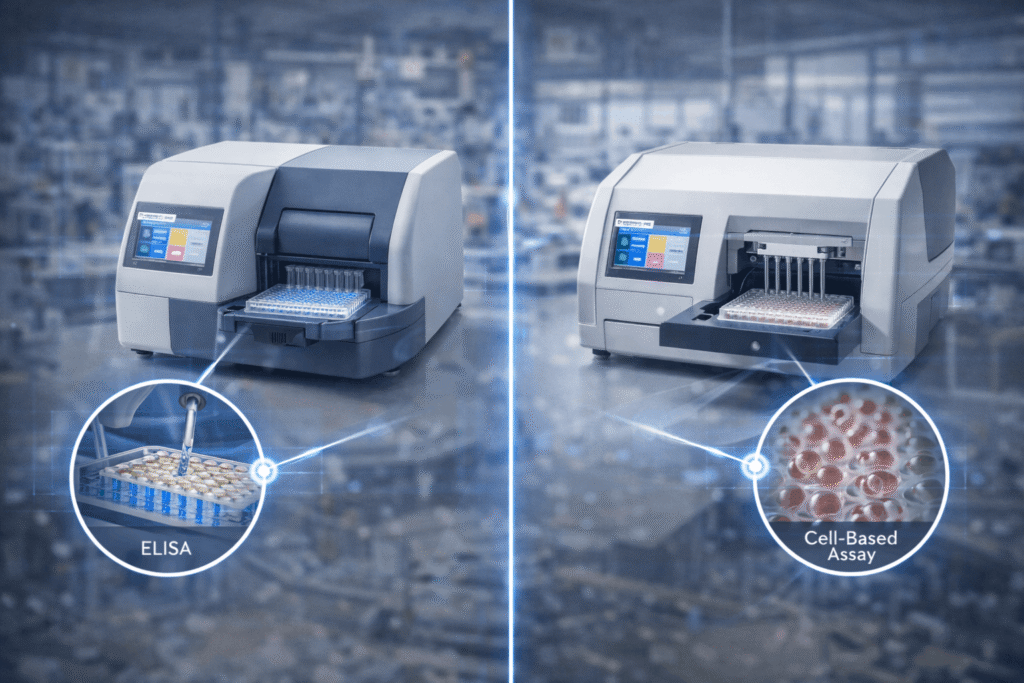
ELISA assays rely on firm surface binding, while cell-based assays involve fragile, living cells. This contrast means washing systems must prioritize precision for ELISA and gentleness for cell-based workflows.
Automated Microplate Washers for ELISA Assays
- Key ELISA Washing Requirements: ELISA requires thorough removal of unbound reagents to reduce background signal. Inconsistent washing directly affects assay sensitivity and precision.
- Ideal Washer Features for ELISA: An automated microplate washer for ELISA should offer precise aspiration height control, consistent dispense volumes, and programmable wash cycles to match assay protocols.
- Common ELISA Washing Challenges: Incomplete aspiration, residual liquid, and uneven washing across wells can lead to variability and false results.
Automated Microplate Washers for Cell-Based Assays
- Unique Challenges of Cell-Based Washing: Cells can detach easily under aggressive washing conditions. Flow rate, dispense angle, and aspiration speed must be carefully controlled to preserve cell viability.
- Ideal Washer Features for Cell-Based Assays: Cell-based systems benefit from gentle dispense modes, adjustable aspiration profiles, and bottom- or angled-dispensing to minimize shear stress.
- Common Cell-Based Washing Risks: Excessive aspiration force or uneven washing can result in cell loss, altered morphology, or compromised assay outcomes.
Key System Differences: ELISA vs Cell-Based Assay Washers
- Aspiration and Dispense Control: ELISA washers prioritize strong, uniform aspiration, while cell-based systems emphasize controlled, low-shear liquid handling.
- Wash Speed and Throughput: ELISA workflows often prioritize speed and high throughput. Cell-based assays favor controlled pacing over rapid cycle times.
- Programmability and Flexibility: Systems supporting both assay types require flexible programming to adjust wash parameters without manual intervention.
- Plate Format and Throughput Considerations: Both assays commonly use 96- and 384-well plates, but wash dynamics vary significantly between formats and applications.
- Integration with Automated Workflows: Automation-ready washers must align with plate handlers, incubators, and readers to maintain workflow continuity.
Choosing the Right Automated Microplate Washer
Selection depends on assay type, throughput requirements, and sensitivity to shear forces. Some labs benefit from specialized washers, while others require configurable systems that adapt across applications.
When a Single Washer Isn’t Enough
High-throughput labs running both ELISA and cell-based assays may require dedicated systems to avoid performance tradeoffs.
Matching the Washer to the Assay
Effective washing is not universal; it is assay-specific. Matching system capabilities to application needs protects data quality and workflow reliability. Copia Scientific supports laboratories in selecting and deploying systems that align with real assay demands.
Contact Copia Scientific to identify an automated plate washer that fits your ELISA, cell-based, or hybrid workflow requirements.