
Material flow issues often surface as missed shipping windows, manual rework, or growing labor strain. When products cannot be routed quickly and accurately, operations slow down, and costs rise. For distribution centers and manufacturing facilities, inefficient sortation within industrial conveyor systems affects throughput, order accuracy, and delivery commitments.
Industrial sortation conveyors address this challenge by automating the separation, routing, and direction of products through a facility. With correct selection, these systems support consistent output and long-term operational stability.
What Is an Industrial Sortation Conveyor?
An industrial sortation conveyor is a material handling system designed to identify and redirect products to specific destinations within a facility. These systems are commonly used in warehousing, manufacturing, and distribution operations where high-volume product movement requires accuracy and repeatability.
Sortation industrial conveyor systems integrate with conveyor rollers, pulleys, sensors, and controls to manage product flow without manual handling. They support organised routing for packaging, shipping, inspection, or further processing.
How Industrial Sortation Conveyors Work
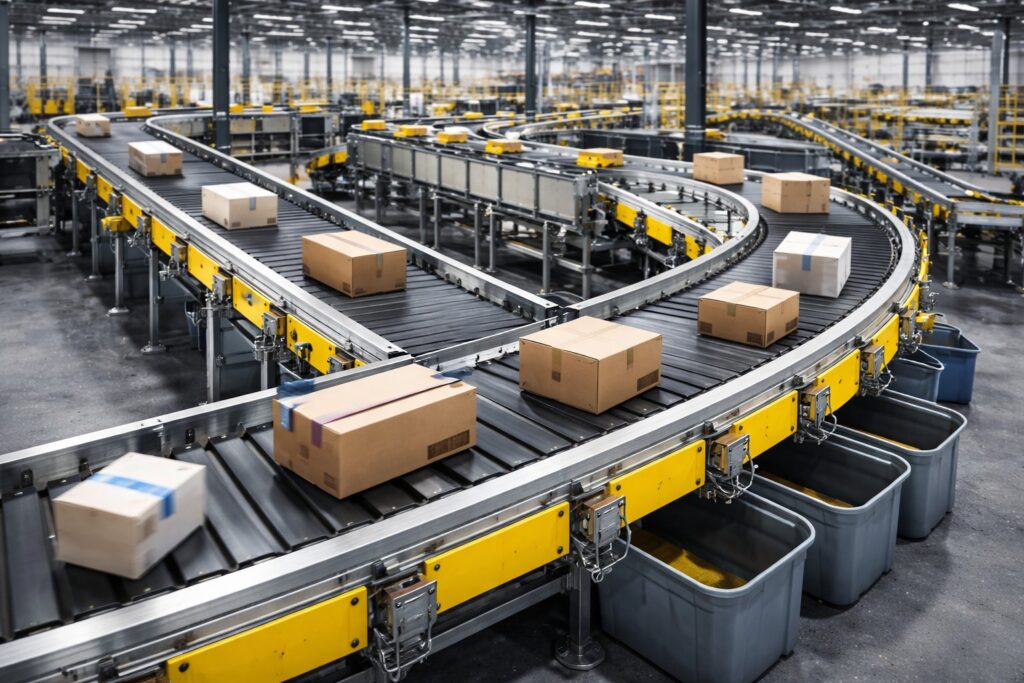
Sortation systems operate through a combination of mechanical movement and automated controls. Products enter the system on a main conveyor line. Sensors or scanners identify each item based on size, weight, barcode, or destination data.
Upon identification, the system activates a sorting mechanism that diverts the product to the correct lane or conveyor path. Conveyor rollers and pulleys maintain controlled movement, while drive components ensure consistent spacing and timing. This coordination reduces congestion and prevents product damage.
Common Types of Industrial Sortation Conveyors
Different facilities require different sortation methods. Common types include:
- Sliding Shoe Sorters: Use moving shoes to push products gently onto designated lanes.
- Pop-Up Wheel Sorters: Raise powered wheels between rollers to redirect items at angles.
- Tilt Tray Sorters: Carry items on trays that tilt to release products at specific points.
- Cross-Belt Sorters: Use individual belts mounted on carts to transfer products laterally.
Each heavy-duty conveyor system relies on durable conveyor rollers and pulleys to maintain alignment and reduce wear during continuous operation.
Key Factors to Consider When Choosing the Right Sortation Conveyor
Selecting the right system requires careful evaluation of operational needs. Key factors include:
- Product Size and Weight: Larger or heavier items require reinforced rollers and pulleys.
- Throughput Requirements: Higher volumes demand systems designed for sustained speed and accuracy.
- Available Floor Space: Layout constraints influence conveyor configuration and sorter type.
- Integration with Existing Equipment: Compatibility with current conveyor systems is critical.
- Maintenance Access: Systems with serviceable rollers and pulleys support longer service life.
Matching Sortation Conveyor Types to Industrial Applications
No single material handling conveyor system or sorter fits every operation. Facilities handling packaged goods often rely on sliding shoe or pop-up wheel systems for controlled routing. Manufacturing environments may use cross-belt or tilt-tray systems in which product orientation varies.
Distribution centers in Pennsylvania and across the United States often require scalable sortation conveyors that adapt to seasonal demand. In these settings, robust conveyor rollers and properly sized pulleys help maintain uptime during peak periods.
Common Mistakes to Avoid When Selecting a Sortation Conveyor
Several issues can limit system performance when overlooked:
- Choosing systems based on speed alone rather than flow control
- Undersizing rollers or pulleys for load demands
- Ignoring future expansion requirements
- Overlooking maintenance access and replacement intervals
- Failing to align the sortation design with the upstream and downstream conveyors
Avoiding these mistakes helps reduce downtime and unplanned costs.
When to Work With a Conveyor Systems Manufacturer
Complex sortation requirements benefit from early collaboration with a conveyor systems manufacturer. Design support ensures that rollers, pulleys, and sortation components work together as a unified system. This approach improves layout efficiency, reduces installation issues, and supports long-term performance of warehouse conveyor systems.
Facilities operating throughout the U.S. often require solutions tailored to specific product flows rather than off-the-shelf configurations. Contact Heinrich Brothers Inc. to discuss industrial sortation conveyor systems that meet the facility’s specific requirements.