
Manufacturing delays, inconsistent tolerances, and rising labour costs continue to challenge businesses that rely on plastic machining and fabrication. When production schedules slip or part quality varies, the impact reaches far beyond the shop floor. Missed deadlines disrupt supply chains, increase rework, and raise operational risk.
Automation is reshaping how leading plastic machining and fabrication services in Canada operate. It helps manufacturers support precision, reliability, and scalability while maintaining quality standards. Many companies operate within this changing environment, where automation supports consistency and efficiency across machining and fabrication workflows.
Understanding Automation in Plastic Machining and Fabrication
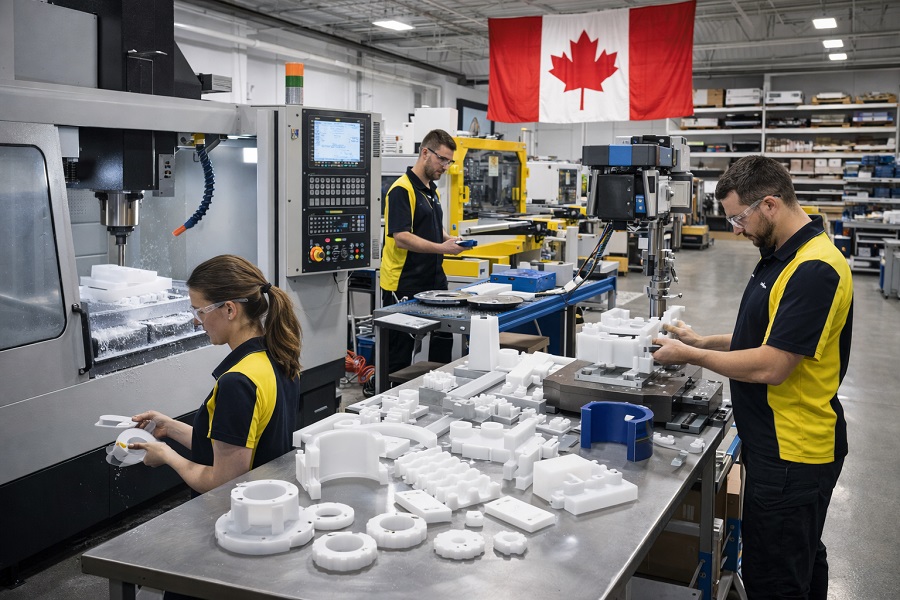
Automation in plastic machining and fabrication refers to the use of programmed equipment, digital controls, and repeatable processes. This helps reduce manual intervention with CNC machining centres, automated cutting systems, and integrated material handling solutions. Rather than replacing skilled labour, automation standardizes repetitive tasks, allowing operators to focus on oversight, setup, and quality assurance.
In plastic machining, automation supports precise material removal and consistent part geometry. In fabrication, it improves forming, bonding, and finishing accuracy while reducing variability between production runs.
Where Automation Fits Into Modern Plastic Machining
Plastic machining often requires tight tolerances, material stability, and repeatability. Automated CNC systems support these requirements by following programmed tool paths with minimal deviation. This approach improves dimensional control when working with materials such as UHMW, acetal, nylon, polycarbonate, and high-performance plastics.
Automation also supports:
- Consistent feed rates and cutting speeds
- Reduced tool wear variability
- Predictable cycle times for scheduling accuracy
These factors help machining operations deliver repeatable results across both low-volume and repeat production.
The Role of Automation in Plastic Fabrication Processes
Plastic fabrication includes cutting, bending, bonding, welding, and assembly. Automation improves these processes by maintaining uniform pressure, heat, and alignment during forming and joining steps. Automated cutting tables and CNC routers ensure clean edges and consistent profiles, particularly for sheet plastics.
By reducing manual adjustments, automated fabrication improves throughput while supporting repeatability across batches.
How Automation Improves Accuracy and Consistency
Manual machining and fabrication rely heavily on operator technique. Even experienced teams can introduce variation over long production cycles. Automation minimizes this risk by executing programmed instructions consistently.
Key accuracy benefits include:
- Stable tolerances across multiple parts
- Reduced dimensional drift during extended runs
- Consistent surface finishes and edge quality
For businesses sourcing plastic components, this consistency supports easier assembly, fewer fit issues, and improved downstream reliability.
Operational Efficiency and Production Scalability
Automation directly improves operational efficiency. Automated systems reduce setup times between jobs and allow faster changeovers. This flexibility supports mixed production schedules without compromising quality.
Scalability also improves. As demand increases, automated machining and fabrication allow production volume to rise without proportional increases in labour or rework. This capability supports predictable lead times, even during periods of fluctuating demand.
Automation and Workforce Collaboration
Automation does not remove the need for skilled operators. Instead, it shifts the workforce’s role toward programming, supervision, inspection, and process optimization. Operators focus on material selection, fixture setup, and quality checks rather than repetitive manual tasks.
This collaboration improves safety, reduces fatigue, and supports consistent output while maintaining human oversight where it matters most.
Industry Applications Benefiting From Automated Plastic Machining
Several industries in Canada benefit from automated plastic machining and fabrication, including:
- Manufacturing and industrial equipment
- Material handling and conveying systems
- Electrical and electronic enclosures
- Food processing and packaging equipment
- Transportation and infrastructure components
Leading plastic machining and fabrication services in Canada use automation to support these sectors with reliable parts that meet expectations.
Considerations When Implementing Automation
While automation offers clear advantages, implementation requires planning. Material properties, production volume, and part complexity influence the necessary level of automation. Investment decisions should align with long-term production needs rather than short-term throughput gains. Successful automation balances equipment capability with skilled oversight and process control.
Automation’s Growing Impact on Canadian Plastic Machining
Automation continues to shape how plastic machining and fabrication services operate across Canada. By improving accuracy, consistency, and efficiency, automated processes support reliable production and scalable manufacturing outcomes. Businesses sourcing plastic components benefit from predictable quality and dependable lead times.
For organizations seeking dependable plastic machining and fabrication services in Canada, consistency is essential.