
Heavy equipment activity generates ground movement that can travel beyond the active work zone, placing adjacent foundations, utilities, and structures under cumulative stress that is rarely visible until damage has already occurred. For contractors, project managers, planners, and infrastructure teams, the cost of unmanaged vibration risk can be substantial, including structural complaints, regulatory intervention, project delays, and avoidable disputes.
Implementing vibration monitoring from the earliest mobilization phase gives project teams a reliable way to stay ahead of these risks. Automated systems provide continuous, uninterrupted oversight across active construction phases, capturing data that manual spot checks cannot consistently replicate. That continuous coverage helps separate projects that remain controlled and compliant from those that face preventable disruption.
People Also Ask
Why is vibration monitoring important in construction?
Vibration monitoring helps manage risk by keeping vibration levels within safe limits, providing documentation for compliance and potential claims, and enabling teams to adjust operations to avoid exceedances that can lead to complaints, delays, or litigation.
How is construction noise monitored?
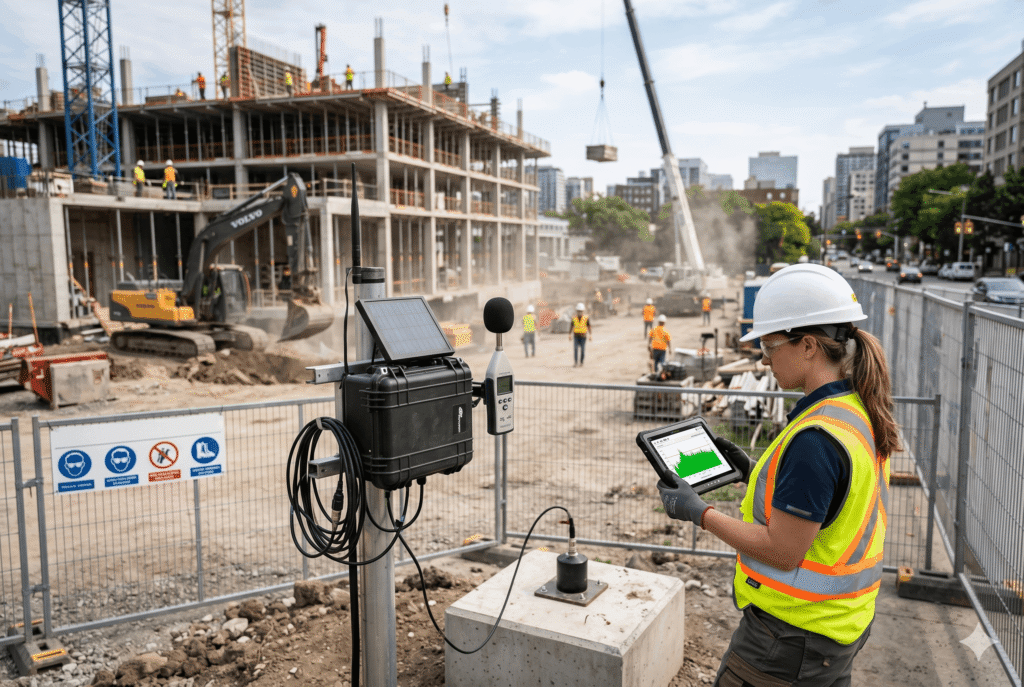
Construction noise can be monitored using anything from handheld sound level meters for spot checks to installed/automated boundary noise monitoring systems that continuously record sound levels and generate reports; some networked systems also upload measurements for real-time viewing and web-based reporting.
Why Vibration Monitoring Matters for Project Success
Unchecked ground movement is one of the most underestimated risk factors in urban construction, infrastructure work, and large-scale residential development. Vibrations from pile driving, demolition, excavation, and heavy haulage can propagate through soil in ways that vary depending on ground conditions, nearby structures, and equipment intensity. As a result, predictive assessment alone may not be enough once construction activity begins.
Continuous construction noise monitoring complements vibration analysis by capturing the broader acoustic and mechanical impact profile of site activity. Together, these data streams give project teams a clearer picture of how construction activity is affecting the surrounding environment. This is especially important where municipal bylaws, project specifications, or regulatory requirements establish defined noise and vibration limits.
A well-maintained monitoring record also creates a defensible, timestamped documentation trail. This helps contractors, owners, and engineering teams respond to complaints, verify site conditions, and demonstrate due diligence. Projects that invest in proactive monitoring are better positioned to reduce regulatory exposure, limit disputes, and maintain schedule continuity.
How Automated Vibration Monitoring Systems Protect Adjacent Structures
Modern automated monitoring systems use field sensors and software platforms to analyze continuous data in real time. These systems can flag threshold exceedances when ground movement approaches levels associated with structural or operational risk. This creates a more reliable risk management framework than periodic manual readings, which may miss short-duration peak events during high-intensity equipment cycles.
Instant alerts allow site managers and engineering teams to respond quickly. Adjustments may include modifying equipment positioning, changing activity sequencing, adjusting work methods, or increasing oversight during sensitive operations. These decisions are most effective when they are supported by accurate data rather than delayed observations.
Integrating geotechnical sensors with acoustic monitoring provides a more complete view of site impact. For complex infrastructure, transit, commercial construction, and multi-unit residential developments, nearby assets may include heritage structures, active utilities, occupied buildings, or transportation corridors. In these settings, construction vibration monitoring supports practical decision-making, regulatory reporting, and defensible project documentation.
Next Steps for Implementing Vibration Monitoring on Your Site
Selecting the right acoustic engineering partner is one of the most important early decisions in any vibration monitoring program. Proper equipment selection, sensor placement, baseline measurement, calibration, alert thresholds, and reporting protocols require qualified engineering judgment. Generic instrumentation rental alone may not provide the level of technical interpretation required for compliance-focused construction monitoring.
Valcoustics Canada Ltd. is a consulting engineer with deep specialization in noise and vibration analysis for commercial construction, infrastructure, transit, wind farm, and large-scale residential development projects. Their engineering team designs monitoring programs around project-specific risk profiles, site constraints, baseline conditions, and applicable regulatory requirements.
Baseline data is especially important before construction activity begins. Without reliable pre-construction measurements, it becomes more difficult to distinguish existing site conditions from construction-related impacts. A structured monitoring program helps establish defensible records, support communication with regulators, and reduce uncertainty during active work.
Partner with Valcoustics Canada Ltd. to design a defensible vibration monitoring program that supports compliance, protects adjacent structures, and helps construction teams manage noise and vibration risk with engineering confidence.