
Laboratories expanding automation capabilities often face a major procurement decision. Should they invest in brand-new automation systems or consider certified pre-owned alternatives that may offer faster deployment and lower upfront costs?
As research, diagnostics, and high-throughput testing environments continue scaling operations, automated liquid handling systems have become essential. They help improve reproducibility, reduce manual errors, and increase workflow efficiency. However, selecting the right acquisition strategy requires balancing cost, deployment timelines, integration requirements, and long-term operational goals.
Understanding the differences between new and certified pre-owned systems can help laboratories make more informed automation decisions.
Cost and Total Cost of Ownership for Automated Liquid Handling
Initial Capital Expenditure vs Long-Term Value
New automation systems often require significant capital investment. For laboratories expanding workflows or managing budget limitations, these upfront costs may delay automation projects or limit scalability.
Certified pre-owned automated liquid-handling systems typically offer substantial acquisition savings compared to new equipment. Since laboratory automation equipment depreciates over time, many organizations are reevaluating whether purchasing new systems always delivers the strongest long-term value.
The right decision depends on:
- Throughput requirements
- Workflow complexity
- Integration needs
- Budget flexibility
- Lifecycle planning
Some laboratories prioritize the newest available technology, while others focus on operational efficiency and faster ROI.
Maintenance and Consumables Compatibility
Maintenance and consumable costs also influence total ownership expenses.
Laboratories should evaluate:
- Service availability
- Replacement part accessibility
- Software support
- Calibration requirements
- Pipette tip compatibility
Certain systems rely on proprietary consumables that increase recurring operational costs. Others support broader compatibility with universal consumables, which may improve long-term budget flexibility.
Evaluating these factors early helps laboratories avoid unexpected operational expenses after deployment.
Deployment Timelines for Automated Liquid Handling Systems
Overcoming OEM Lead Times
Deployment speed has become increasingly important for laboratories scaling testing capacity or expanding automation workflows.
New systems from original liquid handler equipment manufacturers may involve extended production and shipping timelines depending on:
- System configuration
- Inventory availability
- Customization requirements
- Global supply chain conditions
In contrast, certified pre-owned systems often support significantly faster deployment timelines because validated inventory may already be available for installation.
For laboratories facing immediate throughput demands, shorter deployment windows can help reduce operational bottlenecks and accelerate workflow expansion.
Installation and Laboratory Integration
Successful automation projects require more than just equipment delivery.
Laboratories must also evaluate:
- Laboratory information management system (LIMS) compatibility
- API connectivity
- Workflow synchronization
- Instrument communication
- Automation scalability
Integrated deployment planning helps reduce implementation delays and improve long-term workflow performance.
Copia Scientific supports laboratory integration through the Copia 360 System, which combines automation equipment, workflow integration, technical support, and scientific services into a unified operational model.
Laboratories evaluating automation projects should assess both technical compatibility and long-term support capabilities before selecting a system.
Vendor Selection and Support for Automated Liquid Handling
Evaluating Certification Programs
Not all refurbished automation systems follow the same validation standards.
Laboratories considering certified pre-owned solutions should evaluate:
- Inspection protocols
- Calibration procedures
- Software validation
- Warranty coverage
- Testing documentation
Copia Scientific uses the Copia Certification Process (CCP) to evaluate certified pre-owned laboratory equipment before deployment.
The process includes:
- Mechanical and electronic inspection
- Workflow testing
- Software updates
- Calibration verification
- OEM-grade component replacement
This structured approach helps reduce procurement uncertainty while improving confidence in system reliability.
Long-Term Partnership and Service Networks
Ongoing support remains an important factor in automation planning.
Copia Scientific supports laboratories through specialized divisions such as:
- Lab Squad for technical support
- Assay Guru for workflow and assay consulting
- Lab Integrators for automation integration services
These services help laboratories maintain operational continuity while supporting long-term automation performance.
Certified pre-owned procurement strategies may also support sustainability goals by extending equipment lifecycles and reducing unnecessary equipment disposal.
Which Option Is Right for Your Laboratory?
The right automation strategy depends on laboratory priorities, workflow complexity, throughput demands, and financial planning.
New systems may benefit laboratories requiring:
- The latest available technology
- Highly customized configurations
- Long-term standardization across multiple sites
Certified pre-owned systems may better support laboratories seeking:
- Faster deployment
- Lower upfront investment
- Validated performance
- Scalable workflow expansion
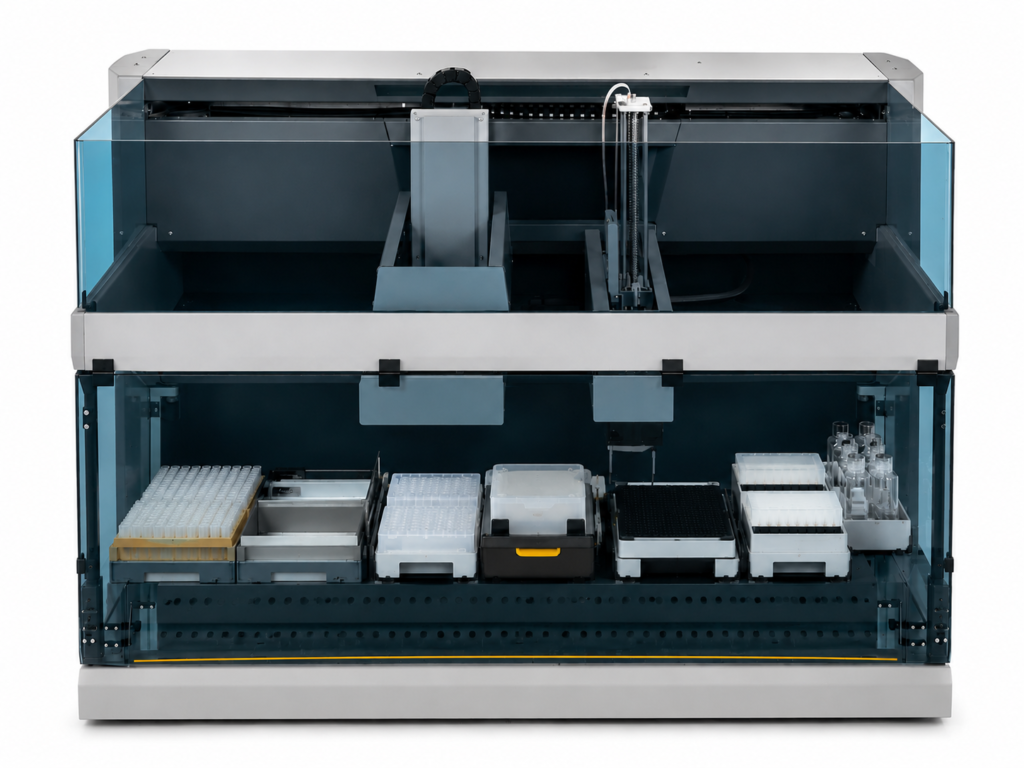
Smaller laboratories may prioritize benchtop systems that improve efficiency without major infrastructure changes. High-throughput facilities may require fully integrated robotic automation platforms designed for continuous operation.
Ultimately, the decision should balance risk mitigation, operational scalability, and capital efficiency.
Laboratories evaluating automation investments should carefully assess integration compatibility, service support, certification standards, and workflow goals. These factors are essential before selecting liquid-handling instruments that align with long-term operational growth.
Need guidance on selecting the right automation platform? Contact Copia Scientific for a personalized workflow consultation and equipment quote.